
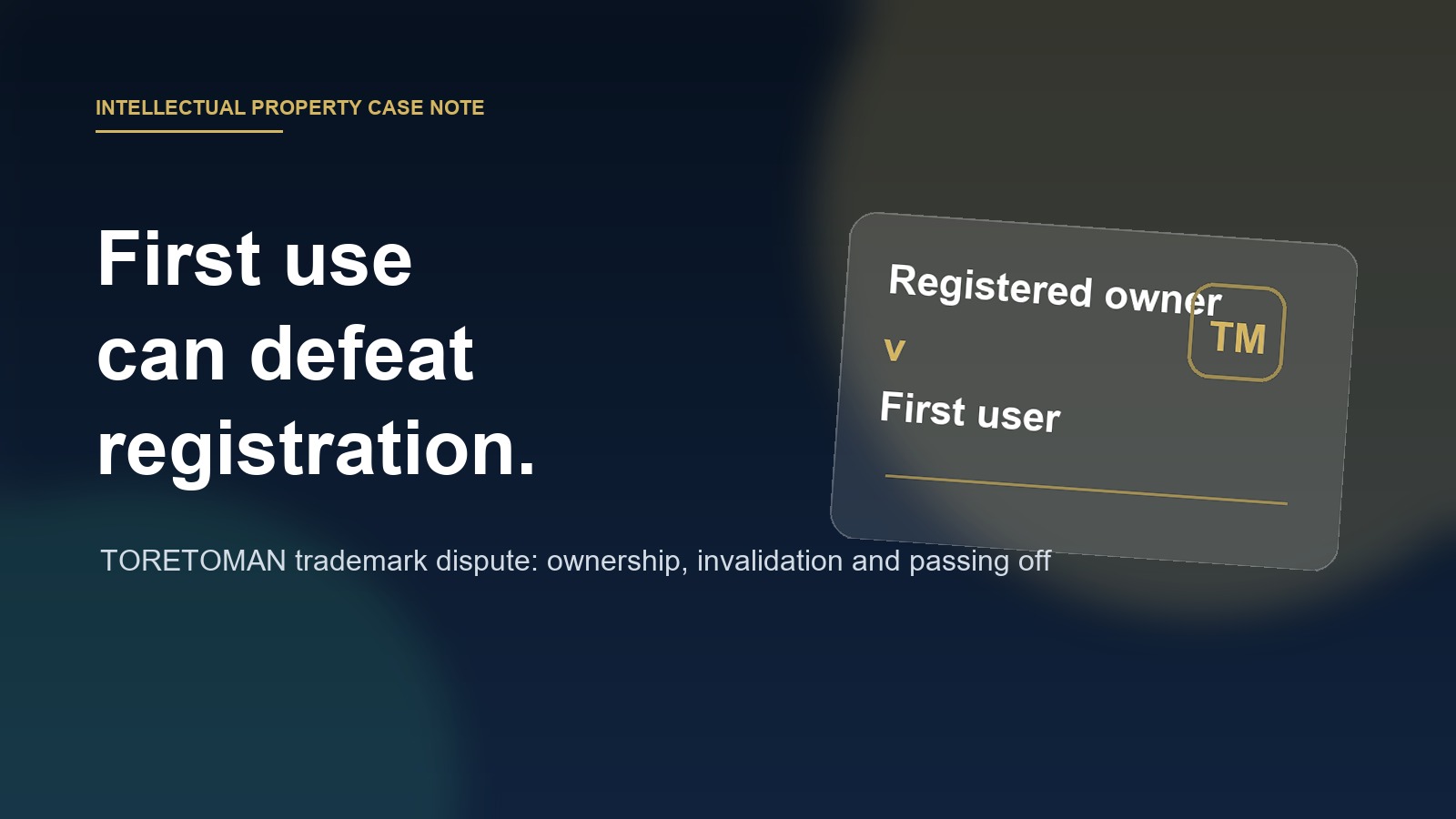
First use can defeat registered ownership.
The TORETOMAN dispute is a useful reminder that a Malaysian trademark registration is powerful, but not untouchable. If the applicant was never the true bona fide proprietor, the registration may be vulnerable to invalidation.
The dispute in brief
In Wei Her Pte Ltd v Ooi Teik Seng & Anor [2023] 3 MLRH 709, the High Court considered common law proprietorship, trademark infringement, passing off and the validity of a registered trademark.
The plaintiff, a Singapore company, had distributed TORETOMAN hair tonic products in Malaysia and Singapore for over 30 years. It later registered the “TORETOMAN” mark in Malaysia in Class 3 for non-medical cosmetics.
The commercial tension
The plaintiff appeared on the register as the owner of the Malaysian trademark. The defendants, however, argued that the plaintiff was merely a distributor and that the true proprietor was the Japanese company behind the TORETOMAN products, Safety Co Ltd.
How the dispute arose
After the plaintiff resigned as distributor, Safety Co Ltd appointed the first defendant to distribute the TORETOMAN hair tonic products in Malaysia. The plaintiff then alleged that the defendants had infringed its registered trademark by distributing TORETOMAN products without its consent.
The defendants resisted the claim and counterclaimed to invalidate the registration. Their central point was not simply whether the mark was similar. It was whether the plaintiff was ever entitled to register the mark as its own.
Long distribution history
The plaintiff distributed TORETOMAN products in Malaysia and Singapore for many years.
Trademark registered
The plaintiff registered TORETOMAN in Malaysia in its own name.
Distributor relationship ended
Safety Co Ltd later appointed a different Malaysian distributor.
Ownership challenged
The defendants argued that Safety Co Ltd, not the plaintiff, was the bona fide proprietor.
The High Court’s decision
The Court accepted that registration is prima facie evidence of ownership. However, that presumption can be displaced where the evidence shows that another party is the true proprietor.
On the evidence, the Court agreed that Safety Co Ltd was the first user and the rightful common law proprietor of the TORETOMAN trademark in Malaysia. This was supported by the parties’ commercial arrangements and documents acknowledging Safety Co Ltd’s ownership.
The plaintiff’s registration was treated as fraudulent because it had registered the mark while recognising, in its agreement with Safety Co Ltd, that the mark belonged to Safety Co Ltd.
Registration rebutted
The register was strong evidence, but not conclusive against the true ownership position.
First user recognised
The first user may retain common law proprietorship even without being the registered owner.
Registration invalidated
The defendants’ counterclaim to invalidate the TORETOMAN registration was upheld.
As a result, the plaintiff’s claims for trademark infringement and passing off were dismissed.
Why this matters for businesses
This decision is commercially important for importers, distributors, franchisees, agents, brand managers and companies dealing with overseas suppliers. A trademark filing strategy must match the real ownership position.
For brand owners
- Register core marks early in Malaysia.
- Control distributor use through written agreements.
- State clearly who owns the mark, goodwill and registrations.
- Monitor filings by distributors or former business partners.
For distributors
- Do not register a supplier’s mark without clear written authority.
- Separate distribution rights from trademark ownership.
- Keep records of authorisation, marketing and permitted use.
- Seek advice before filing a mark connected to another party’s product.
Commentary
The case does not mean that trademark registration is unimportant. On the contrary, registration remains one of the most effective ways to prove and enforce brand rights. The lesson is that registration must be obtained by the correct proprietor and supported by the underlying commercial documents.
Where a distributor, licensee or commercial partner registers a mark that truly belongs to someone else, the registration may become a litigation risk rather than an enforcement weapon. Proper due diligence, clear IP ownership clauses and early filing by the true brand owner remain the best protection.
This article is for general information only and does not constitute legal advice. Trademark ownership, invalidation, infringement and passing off disputes are fact-sensitive and should be assessed on the documents, use history and evidence available.
